



RFID – A New Trend in Smart Management and Operations
15/01/2026
For many years, QR codes have been a familiar tool in retail, logistics, and asset management thanks to their low cost and ease of deployment. However, as operational scale expands and automation requirements increase, RFID (Radio Frequency Identification) is increasingly becoming the preferred choice, gradually replacing QR codes in many real-world scenarios.
This transition is not abrupt, but it clearly reflects enterprises’ growing demand for speed, accuracy, and contactless operations.
Why do QR codes reveal limitations at scale?
QR codes rely on optical scanning, which requires:
- direct line of sight,
- precise alignment, and
- manual scanning of each individual item.
At a small scale, QR codes work well. However, when applied to large warehouses, retail chains, or manufacturing plants, their limitations become increasingly apparent:
- Time-consuming when scanning item by item
- Easily damaged, scratched, or obscured
- Heavy dependence on human operation
- Difficult to fully automate
These factors make QR codes less suitable for high-speed, large-scale operations.
RFID – A technological leap in identification and tracking
Unlike QR codes, RFID uses radio waves, enabling:
- Non-line-of-sight reading
- Simultaneous reading of multiple tags
- Reliable operation in dusty or low-light environments
- Seamless integration with automated systems
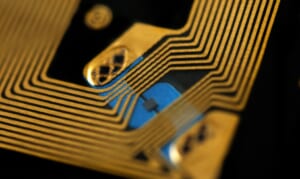
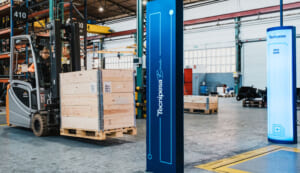
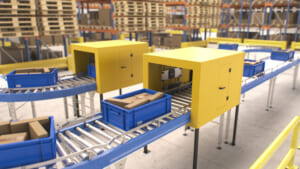
An RFID system consists of several key components, including RFID tags, RFID readers, RFID printers, RFID gate control systems, RFID conveyor systems, and a centralized management software platform. As a result, data can be collected continuously, almost in real time.

Where is RFID replacing QR codes?
1. Warehouse management and logistics
In large warehouses, RFID enables:
- Bulk inventory counting within seconds
- Real-time tracking of pallets and containers
- Reduced inbound and outbound errors
Compared to scanning QR codes item by item, RFID can cut inventory audit time from hours to minutes.
2. Retail and supply chains
Many retail chains are transitioning from QR codes to RFID to:
- Achieve accurate inventory visibility at each store
- Reduce shrinkage and misplacement
- Speed up shelf replenishment
RFID also supports automated stores and cashierless checkout models.
3. Manufacturing and factories
In manufacturing environments, RFID outperforms QR codes due to:
- High durability in harsh conditions
- Tracking semi-finished goods across multiple production stages
- Integration with MES and ERP systems
RFID helps manufacturers achieve transparent production flows and stronger traceability.
4. Asset and equipment management
RFID is widely used to:
- Tag machinery, tools, and equipment
- Track movement and usage status
- Reduce loss and search time
In these scenarios, QR codes are often impractical due to the need for manual scanning.
When should enterprises choose RFID?
RFID is the right choice when enterprises:
- Operate at large scale
- Require high levels of automation
- Need fast, accurate, bulk reading
- Want to reduce dependence on manual operations
Although RFID involves higher initial investment than QR codes, its long-term efficiency and scalability often deliver superior returns.
So sánh kỹ thuật RFID và QR Code
| Criteria | QR Code | RFID |
| Technology | Optical scanning | Radio frequency |
| Line-of-sight required | Yes | No |
| Multiple items read at once | No | Yes |
| Reading speed | Slow (one by one) | Fast (dozens to hundreds at once) |
| Durability | Easily damaged | High durability |
| Level of automation | Low | High |
| Suitability for large scale | Limited | Highly suitable |
| Initial cost | Low | Higher |
| Long-term efficiency | Medium | High |
Case Study: RFID Applications in Retail and Manufacturing
Case 2: Electronics component manufacturing plant
Challenge
- Tracking semi-finished goods across multiple production stages
- QR codes unreliable in dusty, oily environments
- Lack of real-time production visibility
Solution
- RFID tags attached to trays and pallets
- RFID readers installed at production checkpoints
- Integration with production management systems
Results
- Accurate tracking of production flow
- Reduced loss of semi-finished goods
- Improved operational efficiency and traceability
RFID is not merely replacing QR codes—it is reshaping how enterprises manage goods, assets, and operational processes. As demands for automation, speed, and accuracy continue to rise, RFID is becoming a strategic technology across retail, logistics, and manufacturing.
In the coming years, the shift from QR codes to RFID is expected to accelerate, particularly among enterprises pursuing smart, scalable, and sustainable operating models.


Solve any questions from you
Connect with the VTI Commerce team to experience the best products and services.
Contact now